16 February 2016

CHAPTER 8 ACCESSING ORGANIZATIONAL INFORMATION - DATA WAREHOUSE

8.1 Describe the roles and puposes of Data Warehouse and Data Marts.
8.2 Compare the multidimensional nature of  Data Warehouse and Data Marts.
8.3 Identify the importance if ensuring the cleanliness of information throughout an organization.
8.4 Explain the relationship between the business intelligence and a data warehouse.
1. HISTORY OF DATA WAREHOUSE
  • In the 1990’s executives became less concerned with the day-to-day business operations and more concerned with overall business functions
  •  The data warehouse provided the ability to support decision making without disrupting the day-to-day operations, because;
  1.  Operational information is mainly current – does not include the history for better decision making.
  2.  Issues of quality information.
  3. Without information history, it is difficult to tell how and why things change over time.
2. DATA WAREHOUSE FUNDAMENTALS
  •  A Data Warehouse is a logical collection of information-gathered from many different operational database - that supports business analysis activities and decision-making tasks.
  • The primary purpose of a data warehouse is to aggregate information throughout an organization into a single repository in such a way that employees can make decisions and undertake business analysis activities.
  • Data Mart contains a subsets of data warehouse information.
  • The Data Warehouse then send subsets of the information to data mart.
  • Extraction, Transformation, and Loading (ETL) - process that extracts information from internal and external database, transforms the information using a common set of enterprise definitions, and loads the information into a data warehouse.

3. MULTIDIMENSIONAL ANALYSIS AND DATA MINING.
  • Database contains information in a series of two-dimensional tables.
    In a data warehouse and data mart, information is multidimensional, it contains layers of columns and rows.
>  Dimension – A particular attribute of information.
  • cube is the common term for the representation of multidimensional information.
  • Data Mining is the process of analyzing data to extract information not to offered by the raw data alone. It is known as 'knowledge discovery.
  • To perform data mining user needs data mining tools.
  1. Data Mining Tools use a variety of techniques to find patterns and relationships in large volumes in information and infer rules from them that predict future behaviour and guide decision making
4. INFORMATION CLEANSING OR SCRUBBING.
  •  Information cleansing or scrubbing is a process that weeds out and fixes or discards inconsistent, incorrect or incomplete information.
Contact information in an operational system.
Standardizing Customer name from Operational Systems

Information Cleansing Activities

Accurate and complete information.
5. BUSINESS INTELLIGENCE
  • Business Intelligence refers to application and technologies that are use to gather, provide access to, and analyze data and information to support decision-making efforts. 
  • Enabling Business Intelligence
  1. Technology.
  2. People.
  3. Culture.

niaathirah xx
CHAPTER 7 STORING ORGANIZATIONAL INFORMATION - DATABASES.

* Learning Outcomes
7.1 Define the fundamental concepts of the relational database mode.
7.2 Evaluate the advantage of the relational database model.
7.3 Compare relational integrity constraints and business-critical integrity constraints
7.4 Describe the benefits of a data driven web site.
7.5 Describe the two primary methods for integrating information. 
  1. RELATIONAL DATABASES FUNDAMENTALS.
  • Information is everywhere in an organization.
  • Information is stored in databases.
database maintains information about various types of objects (inventory), events (transaction), people (employees) and place (warehouses).
  • Database models include;
> Hierarchical database model is information is organized into tree-like structure that allows repeating information using parent/child relationships in such a way that it cannot have too many relationships.
> The network database model is a flexible way of representing objects and their relationships.
> The relational database model is a type of database that stores information in the form of logically related two-dimensional tables.

Hierarchical Structure
Network Structure
Relational Structure
 3. ENTITIES AND ATTRIBUTES.
  • entity in the relational database model is a person, place, thing, transaction or event about which information is stored.
  • Attributes called fields or columns are characteristics or properties of an entity class.
4.  KEYS AND RELATIONSHIP.
  • primary key is a field (group/fields) that uniquely identifies a given entity in a table.
  • foreign key is a primary key of one table that appears as an attributes in another table and acts to provide a logical relationships between the two tables.


5. RELATIONAL DATABASE ADVANTAGES
  • Databases advantages from a business perspective include;
  1. Increased Flexibility.
  2. Increased scability and performance.
  3. Reduced Information Redundancy.
  4. Increased Information Integrity (Quality)
  5. Increased Information Security.


6. DATABASES MANAGEMENT SYSTEMS
  • A database management systems (DBMS) is software through which users and application programs interact with a database.

7. DATA DRIVEN WEB SITES
  • A data-driven website is an interactive website keep constantly updated and relevant to the needs of its costumer through the use of a database.
  • Data Driven Web Sites Business Advantages.
  1. Development : Allows the website owner to make changes any time
  2. Content management;  A static website requires a programmer to make updates.
  3. Future expandability; Having a data-driven website enables the site to grow faster than would be possible with a static site.
  4. Minimizing human error .
  5. Cutting production and update costs.
  6. More efficient.
  7. Improved stability.

  • Data Driven Business Intelligence.
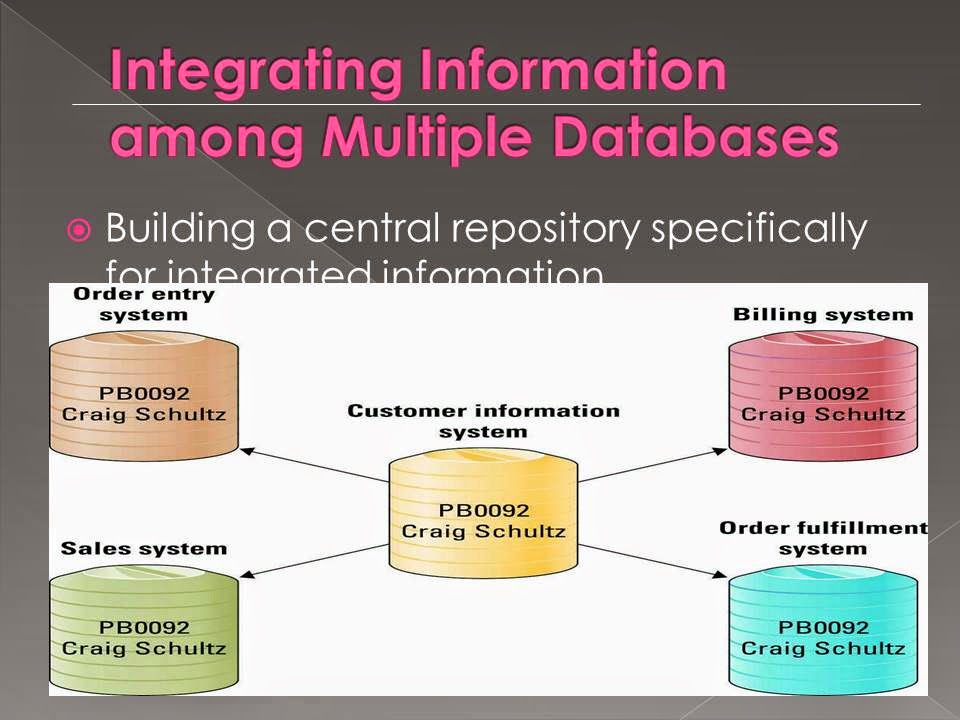
  • Integrating Information among Multiple Databases.

An integration allows separate systems to communicate directly with each other.

> A forward integration takes information entered into a given system and sends it automatically to all downstream processes.
 > A backward integration - takes information entered into a given systems and sends it automatically to all upstream systems and processes.


> Without integration, an organization will;
  • Spend considerable time entering the same info in multiple system.
  • Suffer from the low quality and inconsistency typically embedded in redundant info.


niaathirah xx

02 February 2016

CHAPTER 6 VALUING ORGANIZATIONAL INFORMATION

*Learning Outcomes.
6.1 Describe the broad levels, formats and granulities of information
6.2 Differentiate between transactional and analytical information
6.3 List, Describe and provide an example for each five characteristics.
6.4 Assess the impact of low quality information on an organizational.

  1. ORGANIZATIONAL INFORMATION.
  • Information is everywhere in an organization.
  • Employees must be able to obtain and analyze the many different levels, formats and granularity of organizational information to make decisions.
  • Successfully collecting, compiling, sorting and analyzing information can provide tremendous insight into how an organization is performing.
  •  Levels, formats and granularity of organizational information.

2. THE VALUE OF TRANSACTIONAL AND ANALYTICAL INFORMATION.

  • Timeliness is an aspect of information that depends on the situation.
Real- time Information - Immediate, up-to-date information (weather forecast, touch and go).
Real- time System - Provides real times information in response to query requests (using internet).
  • Business decisions are only as good as the quality of the information used to make the decisions.
  • Characteristics of high-quality information include;

  3. THE VALUE OF QUALITY INFORMATION.
  • Low quality information example.
 

 4. UNDERSTANDING THE COSTS OF POOR INFORMATION.
  • The four primary sources of low quality information include;
  1. Online customers intentionally enter inaccurate information to protect their privacy.
  2. Information from different systems have different entry standards and formats.
  3. Call center operators enter abbreviated or erroneous information by accident or to save time .
  4. Third party and external information contains inconsistencies, inaccuracies and errors.
  • Potential business effect resulting from low quality information include;
  1. Inability to accurately track customers.
  2. Difficulty identifying valuable customers.
  3. Inability to identify selling opportunities.
  4. Marketing to nonexistent customers.
  5. Difficulty tracking revenue due to inaccurate invoices.
  6. Inability to build strong customer relationships.
  • High quality information can significantly improve the chances of making a good decision.
  • Good decisions can directly impact an organization's bottom line.


Niaathirah xx

UNIT TWO EXPLORING BUSINESS INITIATIVES

Exploring Business Iniatives